A groundbreaking study led by “Dr. Nikku Madhusudhan”, an astrophysicist at the University of Cambridge, has revealed tantalizing hints of life-linked gases in the atmosphere of **K2-18b**, a distant exoplanet located **124 light-years from Earth**. Using NASA’s **James Webb Space Telescope (JWST)**, the team detected chemical signatures suggesting the presence of **dimethyl sulfide (DMS)** and **dimethyl disulfide (DMDS)**—molecules on Earth produced *exclusively* by microbial life, such as marine phytoplankton. While the findings are electrifying, scientists emphasize this is not yet definitive proof of extraterrestrial life.


K2-18b: A Hycean World in the Habitable Zone
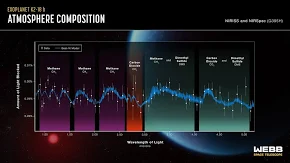
K2-18b orbits a cool dwarf star within the **habitable zone**, where temperatures could allow liquid water to exist. Dr. Madhusudhan’s team proposes the planet is a **Hycean world**—a theoretical class of planets with global oceans beneath hydrogen-rich atmospheres. Previous JWST observations by the same team identified **carbon dioxide** and **methane** in K2-18b’s atmosphere, aligning with Hycean predictions. The latest data, captured using JWST’s Mid-Infrared Instrument, revealed the potential sulfur-bearing molecules, further fueling speculation about biological activity.

Why K2-18b Discovery Matters
On Earth, DMS is a byproduct of marine life, making its detection on K2-18b a compelling—but cautious—biosignature candidate. “A Hycean world with a life-teeming ocean best fits our data,” Madhusudhan stated. However, he stresses the need for skepticism: “We must test and retest our results. This is how science works.” The signals currently meet a **3-sigma confidence level** (a 0.3% chance of being random noise), short of the gold-standard **5-sigma threshold** required for confirmation.
Skepticism and the Road Ahead
The scientific community remains divided. **Dr. Sara Seager** (MIT), a leading exoplanet researcher, notes conflicting interpretations of K2-18b’s nature. Some models suggest it could be a **mini-Neptune** with a hostile, gaseous envelope or even a **molten magma ocean**—far from habitable. Meanwhile, **Dr. Eddie Schwieterman** (UC Riverside) highlights potential inconsistencies, such as the absence of expected ethane in the atmosphere if DMS were present.
Next Steps: More Data, More Questions
The team plans up to **24 additional hours of JWST observations** to strengthen their findings. Madhusudhan acknowledges that even if confirmed, non-biological processes could explain the gases. Independent analysis of the publicly released data will be critical.
A New Era in the Search for Life
While K2-18b’s mysteries are far from solved, this discovery marks a leap forward in **astrobiology**. “The question is no longer *if* we can detect life, but *how prepared we are* to recognize it,” Madhusudhan reflects. As JWST peers deeper into exoplanet atmospheres, each finding brings humanity closer to answering one of science’s oldest questions: **Are we alone in the universe?** For now, K2-18b remains a beacon of possibility—a reminder that the cosmos holds secrets we’re only beginning to unravel.